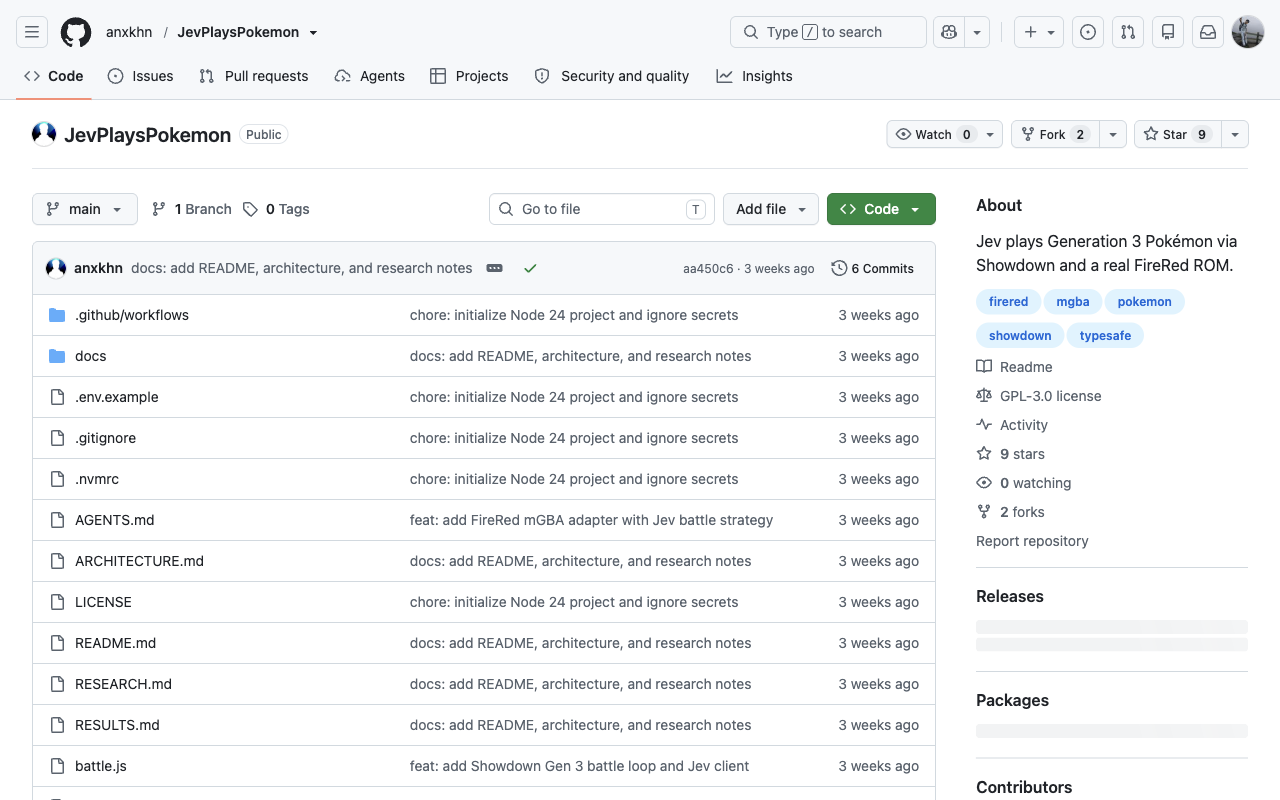
Community · E2 · artifact verified
Pick Pokémon turns from live ROM state
A battle harness reads FireRed state from RAM and lets Jev choose the next legal move or switch while ordinary code advances the fight.
01 · Role in the system
What Jev does here
Each turn the host parses battle state into a JSON snapshot covering party HP, statuses, stats, abilities, PP, weather, and only the moves and switches that are legal right now. Jev returns one action plus a probability for every option, and an illegal answer stops the battle with no fallback model. On the ROM runner, switches are addressed by the Pokémon's personality value so a moving party menu cannot misfire, and damage estimates are computed by code as plain math rather than model suggestions.
Legality by construction, not by prompt
Each turn, the harness parses RAM into a snapshot that contains only the moves and switches that are legal right now, alongside party HP, statuses, stats, abilities, PP, and weather. Jev cannot choose an illegal action because no illegal action is offered — and if it answers illegally anyway, the battle stops rather than falling back to another model.
The failure-proofing details are where this record earns its evidence level: switches are addressed by personality value so a shifting party menu cannot cause the wrong selection, and damage estimates stay in code as arithmetic instead of becoming model suggestions.
Three cents per run, and one underleveled party
The recorded level-40 Elite Four clears cost about three cents of model time per run with a deliberately underleveled party — a striking efficiency number attached, once again, to a single author-recorded run rather than a benchmark, and the record keeps that framing.
Scope limits are explicit: the harness pauses the battle for state reads, and item use, overworld play, and other games are outside the demo. What it does show is the tightest version of the control pattern in the games cluster — a legal-action snapshot, one bounded choice, code that executes and logs.
02 · Control boundary
Where Jev sits
RAM-derived legal action list to one bounded action Choice; deterministic code executes the pick on the emulator or Showdown and records every decision.
Code owns the loop, permissions, thresholds, validation, and side effects. Jev owns only the bounded judgments described above.
03 · Known limits
What this evidence does not prove
- Recorded wins use one deliberately underleveled party; no win rate or repeated-seed evidence is published.
- State reads assume the harness pauses the battle, and item use, overworld play, and other games are outside the demo.
04 · Attribution
Public sources
This is a Community record: the project was published by a third-party community author.