Community · E2 · artifact verified
Search Google Flights in seconds
A browser agent turns the visible DOM into an indexed action space and uses Jev to choose the next operation and compatible target.
01 · Role in the system
What Jev does here
Jev receives a compact table of visible controls and answers an operation Choice plus speculative target Choices in one request. Code reads only the target that matches the selected operation, resolves it back to an observed DOM node, checks freshness and occlusion, and executes it. A separate small text model is called only when the chosen operation needs free text.
Why the action-space shape is what makes it fast
Most browser agents ask a text model to describe what to click and then parse the answer. This harness compiles the visible DOM into a numbered action space first, so a single Jev request returns both the operation and a speculative target for it. The 7.073-second end-to-end search — loading and generation included — is a direct consequence of that shape: one bounded judgment per step instead of a conversation.
The speculative part is the interesting mechanism. Jev answers the operation Choice and compatible target Choices in the same call, and code reads only the target matching the chosen operation, resolves it to an observed DOM node, and re-checks freshness and occlusion before executing. Anything stale fails safe in code rather than being talked around by a model.
How far one recorded run carries the claim
The timing comes from one recorded Zurich-to-London search on one browser profile, and the record says so rather than generalizing it. Frames, canvas content, uploads, pop-up tabs, and arbitrary keyboard widgets are explicitly outside the MVP, which is the difference between a fast demo on a structured booking page and general web control.
As E2 evidence, the artifact itself was inspected and matches the described pipeline. What a reviewer cannot yet infer from this record is a reliability rate across sites or sessions — that number does not exist yet, and the directory treats its absence as part of the result.
02 · Control boundary
Where Jev sits
Browser state to parallel operation and target choices; deterministic code validates and executes one branch.
Code owns the loop, permissions, thresholds, validation, and side effects. Jev owns only the bounded judgments described above.
03 · Known limits
What this evidence does not prove
- The published timing covers one browser profile and one task, not a general reliability benchmark.
- Frames, canvas, uploads, pop-up tabs, and arbitrary keyboard widgets remain outside the MVP.
04 · Attribution
Public sources
This is a Community record: the project was published by a third-party community author.
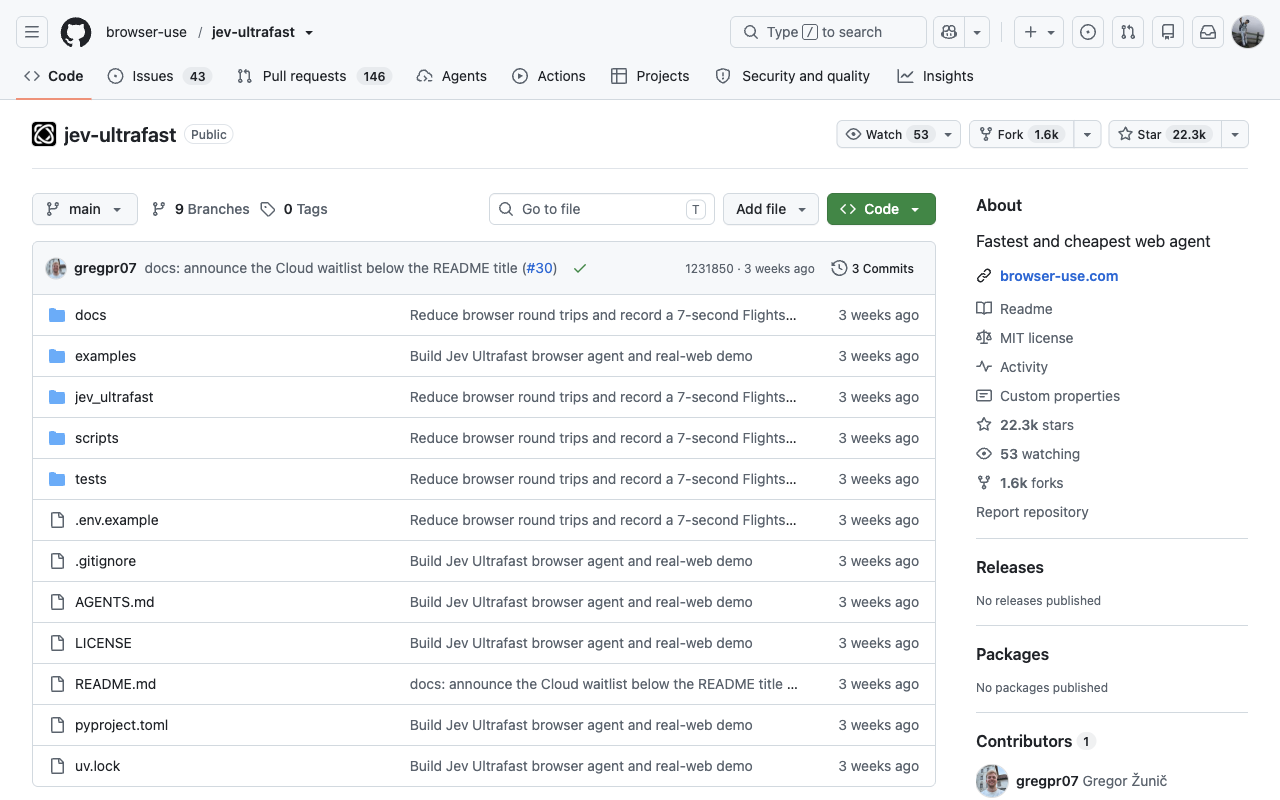
- browser-use ↗Community · github · public · checked 2026-09-18